

Would you like to study the Bible but are not sure where to begin? Let me introduce you to the SOAP Bible study method! This is not a detergent that will remove a stain from your clothes, though it will likely cleanse your heart.
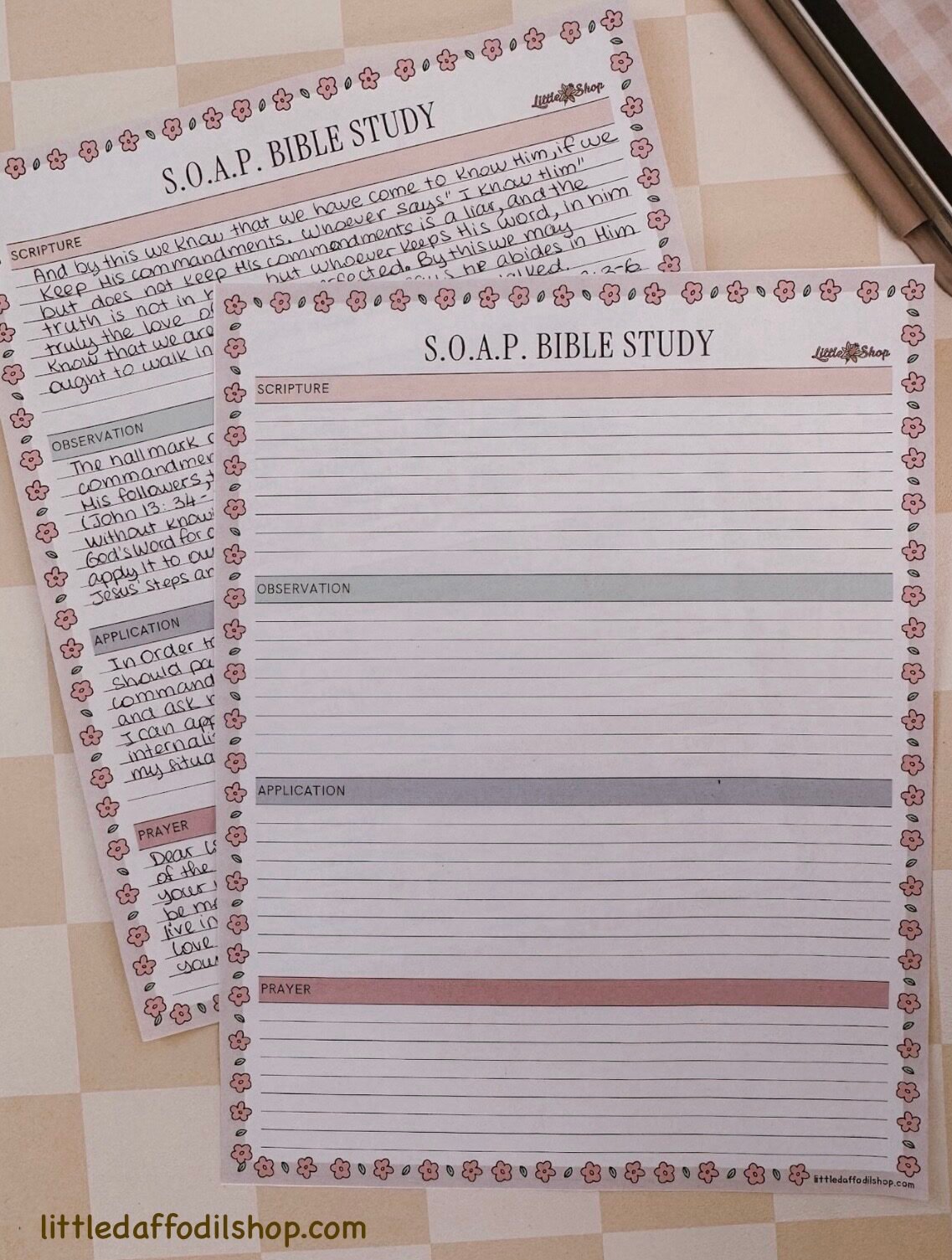
The term S.O.A.P. is an acronym for Scripture, Observation, Application, and Prayer.
This Bible study method is an easy, beginner-friendly method to study God’s word. All you need is a pen and paper, and a hunger for God’s word. You can do it during your alone time with God or in a small group.
I love the SOAP study method because it focuses on applying God’s Word. As Matthew 7:24-27 puts it, we want to be wise men and women who build our lives on the strong foundation of Scripture. What a tragedy if we just hear the word and do not act on it (James 1:23-24).
How to use the SOAP Bible study method
Scripture

You may wonder where to find a Scripture to study. The answer is simple: your Bible reading time. When you read your Bible, you may encounter a verse or short passage that stands out to you, and you would like to remember and understand better. I believe this is the best way to find your Scripture because you are already familiar with the overall context of the passage you want to study.
If you want to study a passage you encountered outside your Bible reading time (like during a sermon or while scrolling on social media), I highly recommend at least reading the chapter it was pulled from.
Once you have your Scripture figured out, write it down. This is an important step because writing will make you pay more attention to what the passage is saying. Then read it slowly a couple of times before moving to the next step.
Observation


Bible verses do not exist in a vacuum.
In this step, remind yourself of the context of the book and the chapter your passage was pulled from. Ask yourself the following questions:
- Who wrote the text and to whom?
- When was it written and why?
- How does your passage fit into the bigger context of the book?
If you are not familiar with the book where the passage comes from, read the book introduction or watch the book summary on the Bible Project YouTube channel. Do not skip this step!
Understanding the passage through the lens of the intended audience is crucial to avoid misapplying it to your modern-day life. Additionally, the context enriches the passage itself.
Take Philippians 4:6-7, for example. This is the go-to verse against anxiety and worry.
When Paul wrote this letter to the Philippians, they were experiencing heavy persecution under Roman occupation. They were not just having a bad day at work or anxious about giving a presentation in front of the whole class. Paul himself was in prison facing threats of execution when he wrote the letter; yet he said, “Do not be anxious”. ( He even says “Rejoice” in verse 4).
You see how knowing the context enriches the verse.
After that, dissect the passage and write what stands out to you. For that,
- Pay attention to the What, Where, Why, Who, and How of the passage.
- Make sure you know what pronouns (‘they’, ‘it’, ‘you’, etc.) refer to
- Take note of repeated words or phrases.
- Read a few commentaries if you struggle with certain terms.
Application

This is where you align your actions, thoughts, and emotions with what the Bible says.
From the passage you’re studying, is there a principle to live by, a command to follow, an attitude to adopt, a promise to trust, a condition to fulfill?
Then, ask the Holy Spirit how you can implement what you just learned into your life. Is there something in your life you should consider changing, believing, or doing?
This is where the right heart posture makes a big difference. You need to be honest with yourself and do some self-examination (Lamentations 3:40). Depending on the passage you’re studying, its application could be a one-time thing or something you commit yourself to doing on a regular basis.
It’s easy to write down a to-do list, but it is harder to follow through. And self-condemnation is always waiting for an opportune moment to get you.
So do not write a long list of “heavy burdens” you cannot carry out of pride. Instead, ask for the guidance of the Holy Spirit and humbly present your plan to apply scripture to God. And remember that the application should not be done through your own effort. After all, God Himself works in you to will and act in order to fulfill His good purpose (Philippians 2:13).
Prayer

Finally, end your Bible study with prayer. Take God’s word back to Him. This is your opportunity to thank God for His Word, confess and repent of any sin He revealed to you, and ask Him to help you apply scripture.
Closing a Bible study in prayer is always a great way to focus on God. After all, He is the reason why we study the Bible and apply Scripture. It also prevents us from making Bible study a mere intellectual pursuit or a simple personal development plan. There is a big difference between knowing God and knowing about God.